
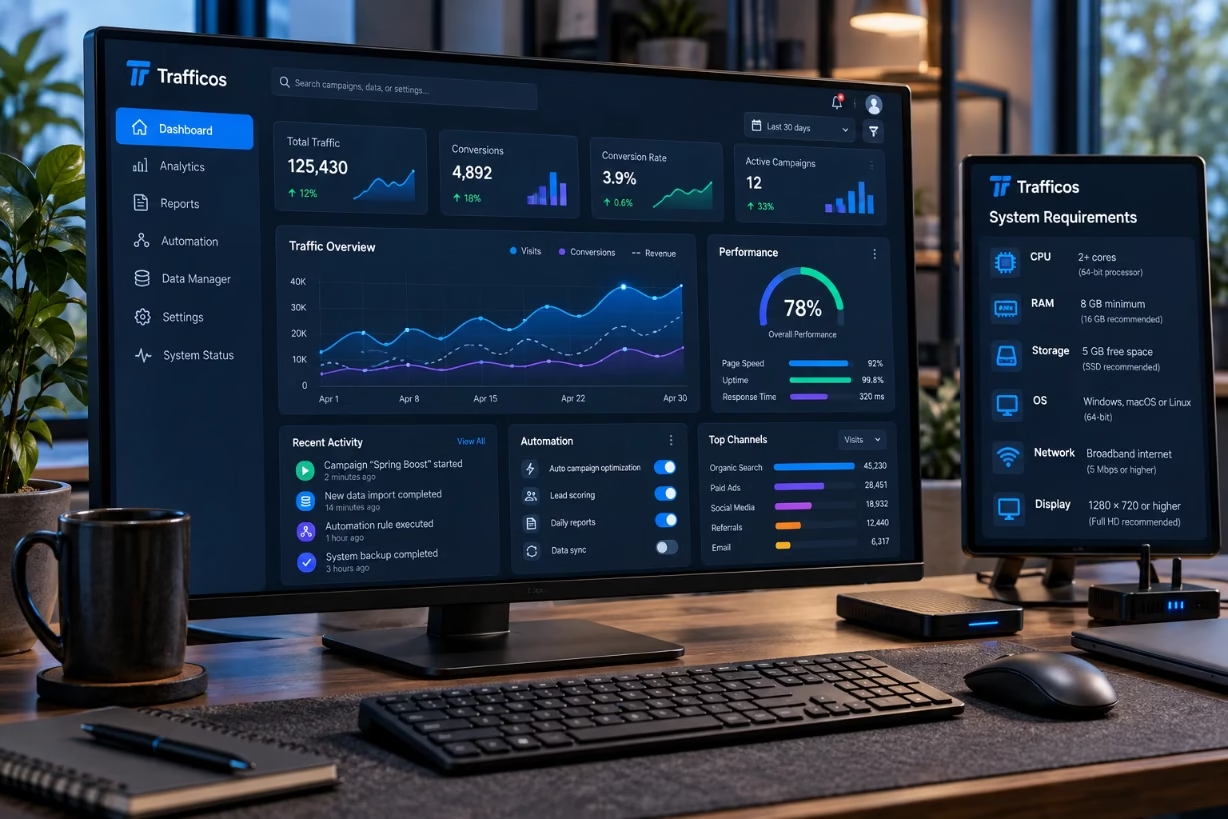
Trafficos is traffic management software that helps you plan, simulate, and optimize vehicle and pedestrian flows, as long as your system meets the right hardware, OS, and graphics requirements so the software runs smoothly and handles complex transport scenarios.
When I first started working with traffic planning tools, I quickly learned that features alone do not decide if a software is useful. The real test comes when you try to run a heavy traffic model on a normal office computer and the whole thing freezes. That is why I want to walk you through trafficos software features and system requirements in a clear, honest way, so you know exactly what to expect before you install or upgrade anything.
What trafficos Software Tries To Solve In Real Projects
At its core, trafficos is built to solve one big problem traffic engineers, planners, and city teams face every week. You need to make decisions about roads, intersections, signals, and parking without guessing. To do that, you need a tool that shows you how traffic moves, where it gets stuck, and what might happen if you change timing, add a lane, close a ramp, or change a bus route.
Trafficos focuses on three practical goals. First, it tries to show how cars, buses, bikes, and people interact in the same space. Second, it helps you test multiple future plans instead of just one fixed layout. Third, it lets you share results in a way that non‑technical stakeholders can understand, like mayors, community groups, or project clients.
When I look at trafficos compared to other traffic tools, I see it as a practical middle ground. It pushes hard on simulation and analysis, but it still tries to stay accessible to users who do not live inside code or scripting every day. That balance is clear in its main features.
Key trafficos Software Features For Traffic Planning
Let me break down the main trafficos software features in a way that matches what you do in real work. I will move from basic design tools to more advanced modeling and reporting functions.
Network And Geometry Design Tools
Every traffic model starts with a network. Trafficos usually gives you an editor where you can draw or import roads, intersections, and links. You define lanes, lane widths, turning pockets, medians, and shoulders. If you work with real cities, you can often import background maps or GIS layers, then trace over them to keep geometry close to real life.
Good trafficos setups will let you define:
- Road types like highways, arterials, local streets, and service roads
- Lane configurations such as left‑turn only, right‑turn slip lanes, or bus‑only lanes
- Intersection control types like stop signs, roundabouts, signals, or uncontrolled nodes
- Speed limits, grade, and sometimes even side friction or parking conditions
The more carefully you build this base network in trafficos, the more reliable your later simulation results usually are. A sloppy network almost always leads to confusing outputs, no matter how good the math is underneath.
Traffic Demand And Route Definition
After geometry, the next trafficos step is demand. You need to tell the software how many vehicles or pedestrians want to move from different points in the network. This often comes from turning counts, origin‑destination matrices, cordon counts, or household travel models.
Trafficos often lets you define:
- Time‑dependent traffic volumes by 5, 10, 15, or 60‑minute intervals
- Vehicle classes such as cars, trucks, buses, bikes, and emergency vehicles
- Pedestrian and bike flows at crossings, shared paths, and midblock crosswalks
- Route choice, either fixed paths or dynamic routing based on travel time
One thing I always stress with trafficos is consistency between your counts and your defined routes. If demand is not balanced to real movement paths, your model might technically run, but it will not reflect actual field conditions. That is where traffic experience matters more than simply knowing which menu to click.
Signal Control And Priority Features
Signal timing is where trafficos can save you hours of manual work. Most modern versions support detailed signal timing at each intersection, including phases, overlaps, offsets, and coordination along corridors.
Typical trafficos signal features include:
- Fixed‑time plans for peak, off‑peak, and weekend periods
- Actuated control with detectors, minimum green, and gap‑out logic
- Transit signal priority or emergency preemption logic
- Pedestrian phases, walk and flashing don’t walk, and leading pedestrian intervals
If you work on arterials, you will probably use trafficos to test how different progression speeds and offsets affect queue spillback and side‑street delay. For downtown grids, it can show how slight changes to cycle length can reduce lost time across a wider area.
Microsimulation And Driver Behavior Modeling
Where trafficos really stands out is in microsimulation. Instead of just giving you volume over capacity ratios, the software models individual vehicles and sometimes individual pedestrians. You see stop‑and‑go waves, shockwaves at bottlenecks, and detailed lane‑changing behavior.
Depending on the build, trafficos usually includes parameters for:
- Car‑following behavior like headway, acceleration, and deceleration comfort
- Lane‑changing rules, including gap acceptance and target lane priorities
- Reaction to congestion, weaving sections, and merge‑diverge points
- Pedestrian walking speed, gap acceptance, and crossing behavior
When I tune a trafficos model, I try not to chase visual perfection. The goal is to match average measures like travel time, queue length, and throughput. If the numbers line up with field data, then the visuals are usually close enough to trust.
Multimodal And Safety‑Related Features
Modern projects rarely look at cars alone. Trafficos works better when you include buses, freight, bikes, and people walking. Many setups let you model bus stops, dwell times, layovers, and even basic rail or streetcar operations. You can track person delay instead of just vehicle delay, which is helpful if your city has transit or walk‑first policies.
For safety, some trafficos versions support conflict analysis. These tools look at simulated vehicle paths and identify potential near‑misses or conflicts by angle, speed, and gap. While this is not a crash prediction model by itself, it gives clues about risky maneuvers and locations where redesign can reduce conflicts.
Scenario Management And Comparison
Real planning work almost always involves multiple alternatives. Trafficos often includes a scenario manager so you can copy base networks, create build options, and switch between them easily. You can test different:
- Lane configurations and turn restrictions
- Signal timings and coordination plans
- Land use assumptions or development phases
- Transit routes, frequencies, or stop locations
The best part is when trafficos gives you side‑by‑side reports, so you can compare delay, level of service, queues, and emissions or fuel use under several alternatives. This type of structured comparison is what decision makers usually want to see in presentations and reports.
Reporting, Visualization, And Stakeholder Communication
Traffic professionals often underestimate how much time they will spend explaining their work. Trafficos helps by offering charts, tables, and exportable outputs, but the visuals are usually what people remember. Videos that show traffic before and after a project can make public meetings easier.
Most trafficos environments let you:
- Generate level of service results for movements, approaches, and intersections
- Export travel time, speed, and volume data across links and routes
- Create heat maps or color‑coded links to show congestion levels
- Export native files, images, and videos for reports and presentations
When I prepare results, I try to keep one version tuned for engineers and another for non‑technical audiences. Trafficos is rich in technical data, but raw tables rarely convince community members. Simple visuals with clear legends carry more weight.
Core System Requirements To Run trafficos Smoothly
Now let me move from features to system requirements. You can have the best trafficos license in the world, but if your hardware cannot handle it, you will fight slowdowns, crashes, or incomplete runs. I will describe typical ranges so you can map them to your computer or IT standards.
Operating System Requirements
Most trafficos builds are developed for modern Windows environments. If you work in a city or engineering firm, this usually aligns with your IT standards.
Common supported versions include:
- Windows 10 64‑bit, fully updated
- Windows 11 64‑bit with recent patches
If your organization still runs older operating systems, you should plan an upgrade before trying to standardize trafficos. Running complex microsimulation on outdated platforms almost always causes stability issues and missing library problems.
Processor (CPU) Requirements
Trafficos traffic modeling is CPU‑intensive, especially when you run big networks or long simulation periods with tiny step sizes. For small networks, entry‑level CPUs might work, but I strongly recommend more power if you want to avoid frustration.
As a practical guide, I usually look at:
- Minimum: modern 4‑core CPU, such as entry Intel Core i5 or AMD Ryzen 5
- Recommended: 6 to 8‑core CPU, such as Intel Core i7 or Ryzen 7
- Heavy users: high‑end workstation chips if you model large regions
Trafficos can often take advantage of multiple threads, especially during simulation runs and result processing. A stronger CPU translates directly into shorter run times, which makes it easier to test more scenarios before deadlines.
Memory (RAM) Requirements
RAM is one of the most underestimated system requirements for trafficos. If you run out of memory during a big simulation, your computer will start using disk space as virtual memory and everything will slow down or even fail.
I generally suggest the following tiers:
- Absolute minimum for small networks: 8 GB RAM
- Comfortable starting point: 16 GB RAM
- For medium to large city networks: 32 GB RAM or more
Remember that trafficos is not the only tool running. You likely have GIS software, spreadsheets, PDF readers, and emails open at the same time. That extra load eats into your usable memory. Aim higher rather than lower if your budget allows it.
Graphics Card (GPU) And Display Requirements
Unlike pure number‑crunching tools, trafficos also has to draw vehicles, networks, and animations smoothly on your screen. This puts some demand on your graphics card. Integrated graphics might handle small models, but long term, a dedicated GPU is a better fit.
Typical guidelines I follow for trafficos are:
- Minimum: recent integrated graphics with 2 GB shared memory
- Recommended: dedicated GPU with at least 4 GB VRAM
- For heavy visualization and 3D: mid‑range or better workstation or gaming‑class card
A full HD monitor is usually enough, but if you work with broad regional networks or multi‑window layouts, a dual‑monitor setup can improve your workflow. High resolution screens make it easier to see lane details and signal heads clearly.
Storage Space And Disk Performance
Storage is not just about space; it is also about speed. Trafficos projects can grow large, especially when you keep multiple scenarios and save long simulation logs or high‑quality videos.
Here is how I usually plan storage:
- Install drive: Solid‑state drive (SSD) for the operating system and trafficos
- Space for software: at least a few gigabytes for program files and libraries
- Project storage: 50 GB or more reserved for models, backups, and exports
If your team works on shared servers, ask your IT group about I/O speeds. Running trafficos projects from very slow network drives can lead to long load times and occasional file corruption if connections drop.
Software Dependencies And Licensing Considerations
Some trafficos versions rely on extra components like runtime libraries, database drivers, or GIS connectors. Many installers will handle these automatically, but in tightly controlled IT environments you may need admin rights or help from your support team.
Licensing is also an important part of system requirements. Trafficos often comes in different editions or modules, such as base planning, microsimulation, or advanced analysis packs. Make sure your license matches the work you do. There is nothing more frustrating than building a nice network only to realize your current license does not allow the type of simulation or export you need.
How To Choose Hardware For trafficos Based On Your Work
Rather than listing abstract numbers, I find it easier to tie trafficos requirements to common user types. Think about where you fit in this list and size your machine accordingly.
Light Users And Students
If you are learning trafficos in school or using it for small corridor studies, you can probably work with a mid‑range laptop that meets the basic system requirements. A 4‑core CPU, 16 GB RAM, SSD, and decent integrated or entry‑level dedicated graphics should be enough for most classroom‑scale projects.
Just keep in mind that if you decide to build a full downtown grid or run dozens of scenarios for a research thesis, you may want to move your models to a stronger machine or a shared lab computer.
Consultants And City Traffic Engineers
For everyday professional use, I usually treat trafficos like any other heavy engineering application. A 6 or 8‑core CPU, 32 GB RAM, SSD storage, and a stable mid‑range GPU will pay for themselves in saved waiting time. When you can run a big PM peak simulation in minutes instead of half an hour, you can test more options and refine your analysis under tight deadlines.
If your office uses trafficos all day across several teams, it can also make sense to build dedicated workstations or even small modeling servers where the most complex networks run overnight or during off‑hours.
Advanced Researchers And Regional Modelers
If you use trafficos for large regional studies, high‑detail microsimulation, or heavy safety and reliability analysis, then you are closer to the world of scientific computing. You will benefit from high‑core‑count CPUs, 64 GB or more of RAM, fast NVMe SSDs, and professional‑grade GPUs. In some cases, you might even consider distributed simulations or cluster setups, depending on what trafficos supports.
This level of hardware is not cheap, but the time savings can be huge when you work with regional networks that take many simulated hours and multiple replications to stabilize.
Best Practices To Keep trafficos Stable And Reliable
Hardware and software versions are only part of the story. The way you manage trafficos projects can also affect performance and reliability. Here are a few habits that I have found useful over time.
Keep Your System Clean And Updated
Try to keep your operating system, drivers, and trafficos version up to date, but avoid casual updates right before major deadlines. I like to schedule updates during quiet periods and keep a log of versions, so I can roll back or troubleshoot if a new patch behaves badly.
A clean system with enough free disk space, updated graphics drivers, and regular restarts will run trafficos simulations more smoothly than a cluttered machine full of unused apps and background processes.
Organize Projects And Backups Carefully
Trafficos project folders can fill up with temporary files and alternative scenarios. Use clear naming for networks, scenarios, and time stamps. Store backups in a separate place, and consider version control for key models. Even a simple folder‑based versioning system can save you from losing days of work to corrupted files or accidental overwrites.
Test Models In Stages Instead Of All At Once
When I build a new trafficos model, I rarely try to simulate everything at once on the first run. I start with a limited area or a short time period to check that signals behave correctly, routes load as expected, and volumes look realistic. Once that passes, I extend time periods and add more detail. This staged approach reduces crashes and makes it easier to spot logic errors.
Document Assumptions Alongside System Specs
Good documentation is part of responsible use of trafficos. When you send results to a client or agency, include not just hardware specs and software versions, but also model assumptions. List the date and source of traffic counts, behavior parameters you changed from defaults, and any simplifications in geometry. This kind of transparency supports trust in the results and makes future updates easier.
Why Matching Features And System Requirements Matters For trafficos
In the end, trafficos software features and system requirements are two sides of the same story. Features tell you what the tool can do simulation, multimodal modeling, signal optimization, reporting. System requirements tell you what kind of environment you need if you want those features to work in real time without constant crashes or delays.
If you are just starting out with trafficos, my advice is simple. Start with a clean, modern Windows system that meets or beats the recommended CPU, RAM, GPU, and storage targets. Learn the basic features on smaller networks first, then grow into more complex projects as you gain confidence. If you already manage big urban or regional models, invest in hardware that matches the scale of your work. The time and frustration you save will outweigh the cost surprisingly fast.
When trafficos runs on the right system, it becomes more than just software. It turns into a daily partner for exploring ideas, testing designs, and building better, safer streets for the people who use them every day.