
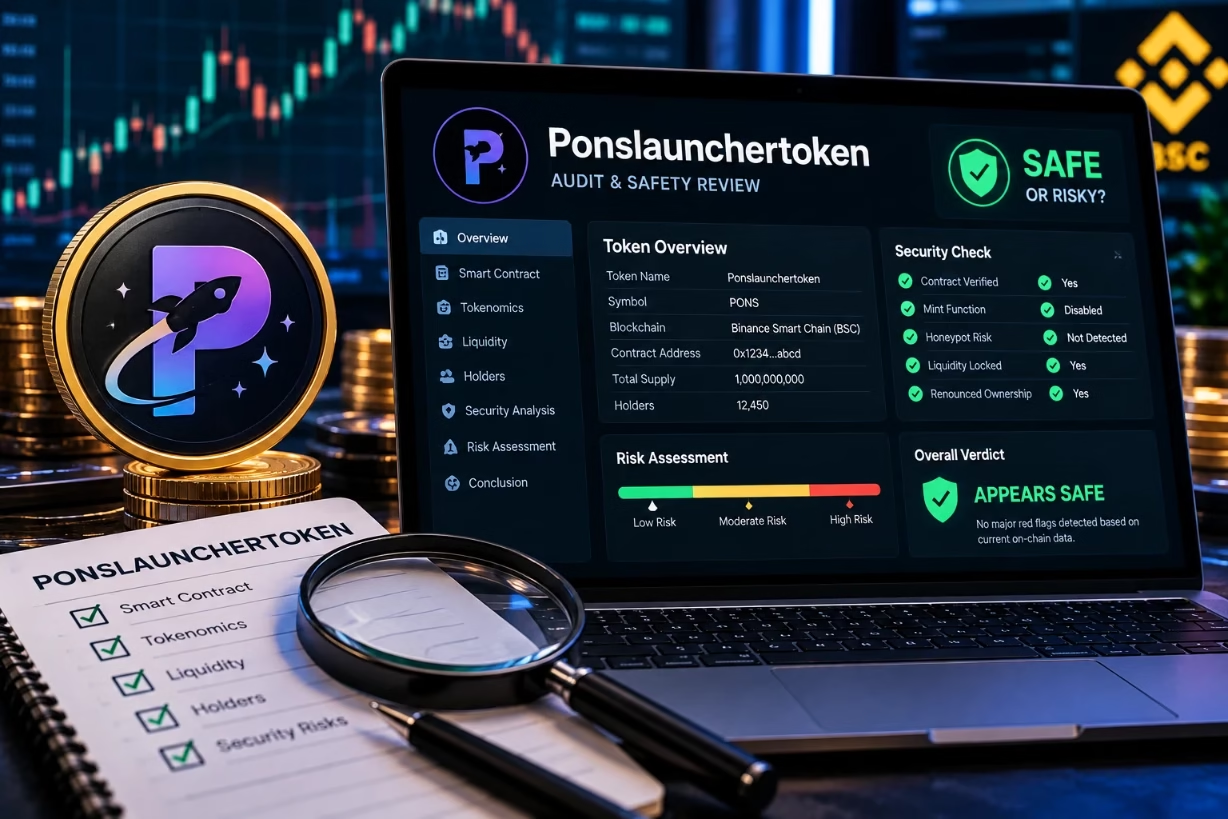
Ponslauncher is a launchpad contract on Robinhood Chain, not a single meme coin. So a proper ponslaunchertoken audit or review or rug safety check means looking at both the shared PonsLauncherToken code and the specific token you are thinking about buying.
What ponslaunchertoken audit or review or rug really means
When people search for “ponslaunchertoken audit or review or rug,” they are usually worried about one thing: can this token drain my money or vanish overnight. I will walk through how the PonsLauncherToken smart contract works, what kind of built‑in safety it has, and what you still need to check yourself before you put real money in.
Quick background: what is PonsLauncherToken on Robinhood Chain
PonsLauncherToken is a fixed‑supply ERC‑20 token implementation used by the pons.family launchpad on Robinhood Chain. Every time someone launches a new token through their PonsLaunchFactory, the factory deploys a fresh PonsLauncherToken contract with that project’s name, symbol, logo, and socials, then seeds liquidity on Uniswap V3 style pools.
This matters for any ponslaunchertoken audit or review or rug check because you are not dealing with random copy‑paste contracts every time. Most launches rely on the same shared codebase. That makes it easier to reason about what the contract can and cannot do, and it also means the usual “hidden mint” or “stealth tax” tricks are harder to hide.
Core contract design: what the code actually does
I will not drown you in Solidity, but you need to know the main moving parts of PonsLauncherToken to do a serious ponslaunchertoken audit or review or rug safety check.
Fixed supply minted once
The total supply is set in the factory’s launch configuration. At deployment, the full supply is minted once to the launch factory itself. There is no mint function for the deployer to call later. After launch, no one can quietly create more tokens to dump into the pool. That alone removes one of the classic rug vectors.
Liquidity seeded and locked via factory and locker
The PonsLaunchFactory pairs the new PonsLauncherToken with a base asset (usually WETH on Robinhood Chain) and creates a Uniswap V3 style liquidity position. That position is then handed to a separate locker contract, where it stays under predefined rules. The project team does not just hold the LP NFT in a wallet they can yank at any time. For a ponslaunchertoken audit or review or rug, this liquidity flow is a key part of the story: if liquidity is truly locked in that locker, the usual “pull all LP and vanish” move becomes much harder.
Restriction window: anti‑snipe and anti‑whale rules
Right after launch, the token has a short restriction window measured in blocks. During this window, only buys that come out of the liquidity pool into user wallets are watched. Two main limits exist:
- Max wallet limit: a wallet cannot hold more than a fixed percent of total supply, like 5 percent.
- Max cumulative buy limit: a wallet cannot buy more than another nearby percent from the pool during the window.
This logic is baked into PonsLauncherToken itself. It only throttles pool‑to‑wallet buys, not ordinary transfers between wallets or LP adjustments. The idea is simple: bots cannot snipe half the supply in the first second, and one wallet cannot hoard most tokens while everyone else gets crumbs.
No transfer tax, no blacklist, no silly tricks
One of the nicest parts for buyers is that PonsLauncherToken is clean: there is no built‑in transfer tax, no blacklist list, and no weird reflection mechanics. Once the restriction window ends, the token behaves like a normal ERC‑20. For any honest ponslaunchertoken audit or review or rug verdict, this simplicity matters. The more “magic” the code packs into the transfer logic, the easier it is for a dev to slip in traps. Here, the behavior is mostly plain vanilla.
What PonsLauncherToken can still not protect you from
Even with this shared, open code, you can still lose money in a token launched through Pons. A good ponslaunchertoken audit or review or rug safety check has to talk about social and economic risks, not just code.
Team dumping their own bags
The dev or creator receives tokens one way or another, often either through the initial buy that happens in the launch transaction or through tokens sent to a fee wallet. Nothing in the PonsLauncherToken code stops the team from selling those tokens later. So you can be safe from a pure contract rug and still get hit by a slow drain as the creator sells into every rise.
Hype cycles and zero fundamentals
A token can be “safe” from a code perspective and still trend straight to zero. If the only draw is memes and short‑term hype, price can collapse as early buyers take profit and new buyers dry up. A fair ponslaunchertoken audit or review or rug safety check always separates “can the contract steal from me” from “could this be a bad trade.” Those are different questions.
Impersonators and fake tokens
Because the code is open and multiple projects use PonsLauncherToken, scammers can create launches that copy the name or ticker of a real project and then promote the fake as the real one. Your ponslaunchertoken audit or review or rug work has to include checking the exact contract address from reliable sources, not just looking at the name or logo.
How I would do a ponslaunchertoken audit or review or rug safety check
Let me walk you through a simple checklist you can repeat yourself any time you see a new token launched through Pons. You do not need to be a Solidity dev to follow this, just careful.
1. Confirm it is really a PonsLauncherToken
First, open the contract page on a Robinhood Chain explorer. You should see that the contract type or source code matches PonsLauncherToken and that it is verified. The code should import OpenZeppelin’s ERC20 and list immutable values like deployer, launchFactory, dexFactory, pairToken, poolFee, and restrictionEndBlock.
If you do not see verified source or you see custom methods that are not part of the public Pons repo, slow down. A real ponslaunchertoken audit or review or rug should fail at this step if the token is pretending to be part of Pons but is actually custom code.
2. Check who launched it and when
Look for the TokenLaunched style event or the transaction where the token was created. The sender should be the official PonsLaunchFactory address, not some random wallet. If a token calls itself a Pons launch but the deployer is a normal externally owned account with no factory in between, treat that as a huge warning sign.
The date and block height also matter. Very fresh launches are much more volatile and easier targets for coordinated pumps or snipes, even if the code is honest.
3. Review basic token settings
On the contract page, confirm totalSupply, decimals, and the restriction parameters. Max wallet and max transaction basis points show how strict the early limits are. If maxWalletBps or maxTxBps are set unusually high, large holders might be able to gather huge amounts early and then control the market later.
For a serious ponslaunchertoken audit or review or rug check, I like to convert those basis points into simple percentages. For example, 500 basis points equals 5 percent of total supply per wallet. That means at most twenty wallets can hold the full supply inside the restriction window.
4. Verify liquidity and its lock status
Next, inspect the main trading pair on the Robinhood Chain DEX that Pons uses. Check:
- How much base asset (like WETH) is paired with the token.
- Who owns the liquidity position (it should be the locker contract, not the dev wallet).
- Whether there are other side pools with strange settings that could drain value.
A ponslaunchertoken audit or review or rug call is only positive if liquidity is both real and locked. Thin or unlockable liquidity makes it simple to pull most value at once, even if the token code itself is fine.
5. Study holder distribution and top wallets
Most explorers give you a Holders tab. Open it and check:
How much of the supply sits in the top 10 wallets. Excluding the known liquidity locker and maybe the official team wallet, high concentration is risky. If a single wallet holds 30 or 40 percent, that wallet’s choices shape the entire chart.
Whether multiple top wallets were funded from the same source shortly before launch. That might mean a single entity split its stack across many addresses to dodge max wallet rules. A careful ponslaunchertoken audit or review or rug safety check looks at transaction history, not just raw percentages.
6. Look at social links and off‑chain presence
PonsLauncherToken stores a Socials struct with Twitter, Telegram, Discord, website, and farcaster fields. On a verified token you can often read these directly from the contract. Then you match them with real, active profiles.
If socials point to empty accounts, dead communities, or completely different projects, that is a red flag. Your “ponslaunchertoken audit or review or rug” research should include stepping into the chat, reading pinned posts, and seeing how the team talks about risk, taxes, and contract safety.
7. Watch early trade behavior
Finally, look at early trades:
- Are the largest buys and sells coming from a few related wallets
- Is volume organic, or mostly wash trade between the same addresses
- Did the team do an obvious “buy heavy then insta‑dump” play on day one
On‑chain behavior tells you as much as contract audits. A truthful ponslaunchertoken audit or review or rug call will say “the code looks clean, but early behavior shows aggressive dumping,” if that is what the data says.
Pros of buying tokens launched through Pons
Let me balance things by listing why people like trading these tokens in the first place. A solid ponslaunchertoken audit or review or rug safety check should not be doom‑only.
Shared, open source contracts
Because Pons uses a shared, open GitHub repo for PonsLaunchFactory and PonsLauncherToken, a lot of eyes land on the same code. Bugs and sneaky rug features are more likely to be caught early. This is very different from random, closed‑source coins where you have to guess what the bytecode does.
Clear anti‑snipe rules
The restriction blocks, max wallet, and max transaction logic directly attack common launch‑day sniper advantages. That means real buyers sometimes get a fair chance to enter instead of watching bots eat the entire first candle.
Simple tokenomics
With no taxes, no reflection, and no rebase games, it is easier for normal users to understand what they are buying. This simplicity also makes audits easier, which is a plus for your ponslaunchertoken audit or review or rug work.
Cons and remaining risks
Still, I want you to stay sober about the downsides.
Config changes and multiple factories
Pons has more than one factory version and can change launch configs like supply, max wallet bps, or restriction length over time. Your ponslaunchertoken audit or review or rug should never rely on a single blog post or old screenshot. Always check the live factory and launch config values that your specific token used.
Tools that game the system
There are open‑source “launch engines” and bundle tools built around Pons that let one person control many wallets at once. Each wallet gets its own max wallet and max transaction slot, so with enough prep, a skilled user can still accumulate a huge slice of the supply inside the rules. Anti‑snipe is not a magic shield, just a speed bump.
No guarantee of long‑term value
Even with all the structure, most launched tokens will not hold value forever. For every success story you see on social media, there are dozens of quiet charts that spike then fade. A careful ponslaunchertoken audit or review or rug check has to end with your personal risk choice: how much can you lose without losing sleep.
Practical red‑flag list for any Pons launch
If you want a quick way to say “this ponslaunchertoken audit or review or rug test fails, move on,” here are some obvious deal breakers:
- Contract is not verified or does not match PonsLauncherToken at all.
- Token was not created by an official PonsLaunchFactory address.
- Liquidity sits in a normal wallet, not the locker contract.
- More than half the supply is in one or two unknown wallets.
- Social links on the token point to dead or fake accounts.
- Team refuses to share the exact contract address in public chats.
If two or more of these flags show up, I personally would fail that token on my own ponslaunchertoken audit or review or rug checklist and keep my funds out.
How to stay safer while trading Pons tokens
I cannot turn crypto into a risk‑free game for you, but I can give a few habits that make a real difference over time.
Use a separate hot wallet
Keep a wallet just for degen trades on Robinhood Chain. Do not mix it with the wallet that holds your main stack. That way, even if a new DApp or contract acts badly, the damage is capped.
Start with small test buys
When a token passes your ponslaunchertoken audit or review or rug check on paper, begin with a small test buy and sell. Make sure the DEX trade works in both directions and that there is enough liquidity to swap back without horrible slippage.
Avoid chasing every fresh launch
Not every new token deserves your time, even if the code is clean. Waiting a few hours or a day lets a lot of scams and weak projects reveal themselves through behavior. There will always be another chart tomorrow.
Keep reading the official docs
The Pons team updates docs and repos as they ship new versions or change parameters. When you care about a specific ponslaunchertoken audit or review or rug verdict, spending a few extra minutes cross‑checking the live factory and documentation is worth it.
Closing thoughts on ponslaunchertoken audit or review or rug calls
PonsLauncherToken, as a shared ERC‑20 blueprint, removes many classic rug pulls: hidden minting, stealth taxes, simple LP pulls straight from the deployer wallet. That is a big step forward compared to totally unstructured meme launches. But a real ponslaunchertoken audit or review or rug safety check still has to look beyond the contract to the human side: who holds supply, who controls the story, and how they behave once the token starts trading.
If you treat every Pons launch as a fresh case, confirm the contract, verify the factory, examine liquidity and holders, and listen to your own risk tolerance, you give yourself a much better shot at surviving the wild days of Robinhood Chain launches with your capital and your sanity mostly intact.